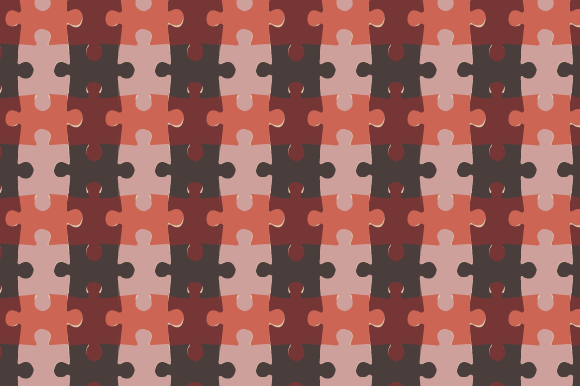
Creative Puzzle Pattern Design
Creative puzzle pattern design blends art, logic, and utility into a single downloadable asset. Whether you are building a brand identity, creating a classroom activity, or crafting a unique piece of wall art, a well-designed puzzle pattern can serve as both a visual anchor and a functional structure. The availability of EPS and PNG files makes these patterns accessible across workflows, from professional printing to digital prototyping. Understanding what these designs offer and how they fit different needs can help you make a smarter choice for your next project.
What Creative Puzzle Pattern Design Actually Means
At its core, a creative puzzle pattern design is a repeating or structured arrangement of interlocking shapes, often inspired by jigsaw puzzles, tangrams, or geometric tessellations. Unlike a generic repeating texture, a purposeful puzzle pattern uses negative space, color variations, and alignment to create a unified visual that can be used in backgrounds, product packaging, textiles, or even user interface elements. The design may be symmetrical or asymmetrical, abstract or representational, but it always carries a sense of play and connectivity.
The downloadable files typically come in two formats: EPS (Encapsulated PostScript) for scalable, editable vector graphics, and PNG (Portable Network Graphics) with transparency for immediate raster use. The combination offers flexibility for both designers who need to modify elements and non-designers who just want a ready-to-use image.
Why Different Audiences Care About Puzzle Patterns
The value of a puzzle pattern shifts depending on who is looking at it. For a graphic designer, the pattern is a modular system that can be resized, recolored, and nested inside other compositions. For a small business owner, it might be the defining texture on a product label or an e-commerce banner that catches the eye. Educators often see puzzle patterns as a teaching tool for spatial reasoning, pattern recognition, and collaborative problem-solving. Hobbyists and DIY creators might use them for scrapbooking, card making, or printed home decor. The same design can spark completely different uses because the underlying format (EPS for editing, PNG for instant application) respects different workflows.
For Beginners and Hobbyists
If you are just starting with creative projects, an EPS file might seem intimidating. Yet many puzzle patterns come with well-organized layers and simple color palettes, making them easy to open in free software like Inkscape or even online editors. The PNG file gives you a drop-in image that you can place directly into a flyer, slide background, or social media post. Beginners often prioritize ease of use and cost. A single download that provides both a vector and a high-resolution raster means you avoid spending time converting formats or worrying about pixelation when printing. For a hobbyist making greeting cards at home, a PNG with transparency lets you layer the pattern over a photo without extra clipping masks. That immediate usability often matters more than deep customization.
For Professionals and Creators
Experienced designers and creators look for flexibility and quality. An EPS file from a creative puzzle pattern design is expected to contain clean curves, proper anchor points, and scalable gradients if any. The ability to ungroup elements, swap colors, and even separate individual puzzle pieces becomes essential when the pattern needs to adapt to a brand’s specific color palette or a client’s layout. Professionals also care about file reliability—whether the EPS opens without errors across different vector editors (Adobe Illustrator, Affinity Designer, CorelDRAW) and whether the PNG is truly transparent without jagged edges. The download details matter: a well-prepared package includes a preview, clear file naming, and optionally a license file. For a creator selling on a marketplace, the pattern’s commercial value depends on whether the license allows resale or incorporation into products. A restrictive license might limit use, while a permissive one opens revenue opportunities.
For Educators and Trainers
Teachers and trainers often evaluate creative puzzle patterns based on learning value and presentation. A puzzle pattern used in a worksheet or a classroom poster must be visually clear at different sizes. The PNG file ensures that even a small image projected on a screen remains sharp, while the EPS can be printed on large poster paper without losing detail. Educators may also look for patterns with distinct shapes and colors that help students identify matching pairs, complete sequences, or practice cutting along curves. The pattern’s inherent repetition can serve as a scaffolding tool for younger learners or as an aesthetic element in adult education materials. Speed and reliability are priorities—no teacher wants to spend class time troubleshooting a file that doesn’t render correctly. A tested, clean EPS and a high-DPI PNG (300 ppi or higher) save time and frustration.
For Business Owners and Entrepreneurs
Small business owners and entrepreneurs often weigh commercial value and long-term usefulness when choosing a puzzle pattern. The pattern might appear on merchandise (mugs, phone cases, fabrics), on the company website, or in packaging. In these use cases, the EPS file is critical because it allows the pattern to be tinted, rotated, or cropped to fit different product shapes. The PNG serves as a quick mock-up for presentations or social media previews. Business owners also need to consider whether the pattern is trendy or timeless. A highly specific puzzle theme (like dinosaurs or flowers) might work for a seasonal launch, whereas an abstract geometric puzzle pattern offers more longevity across multiple product lines. Cost matters, but so does the license: a pattern that can be used for unlimited commercial applications without attribution usually justifies a higher upfront price. Evaluating the download details—file size, included variations, and any documentation—helps avoid surprises down the road.
Understanding EPS and PNG Files for Puzzle Patterns
The choice between EPS and PNG isn’t simply about vector versus raster. EPS files store mathematical definitions of shapes, so you can resize a puzzle pattern from a postage stamp to a billboard without any quality loss. They also let you edit individual puzzle pieces—change a color, delete a section, or combine with other vectors. This is invaluable when the pattern needs to become part of a larger layout. PNG files, on the other hand, are pixel-based but support transparency, making them ideal for layering over photographs or colored backgrounds without a white box. A high-quality PNG exported at a resolution suitable for screen or print (e.g., 150–300 ppi) will look crisp on most devices and at common printing sizes. When you download a creative puzzle pattern, check that the PNG matches the same design as the EPS, and that the transparent areas are cleanly cut without leftover edge pixels.
Practical Examples Across Different Projects
- Freelancer designing a children’s book cover: Opens the EPS in Illustrator, selects only a few puzzle shapes to place around the title, recolors them to match the story palette, and exports a PDF. The PNG is used for a quick social media teaser.
- Micro-brewery owner creating beer labels: Uses the puzzle pattern as a background texture on labels. The EPS ensures the print shop has a vector file for large runs, while the PNG is uploaded to an online mock-up generator to preview the label on a bottle.
- Math teacher preparing a classroom activity: Prints the PNG directly onto card stock for students to cut out and reassemble. The EPS is kept on file in case the pattern needs to be enlarged for a poster or simplified for younger students.
- Blogger adding visual interest to articles: Places a PNG puzzle pattern behind key quotes using a transparent overlay. The light, repeating design adds texture without distracting from the text. Later, uses the EPS to create a custom header image with brand colors.
How to Evaluate if a Creative Puzzle Pattern Fits Your Needs
Before downloading a puzzle pattern design, ask yourself a few questions. First, what is your primary use—screen, print, or both? If print, you need a high-resolution EPS and a PNG at 300 ppi. If only digital, a 72 ppi PNG might suffice, but an EPS still gives you future-proof scalability. Next, consider your editing skills. Beginners will rely more on the PNG out of the box, while intermediate and advanced users will want an EPS that is well-organized—layered by color or piece type, not a single merged shape. Also review the license. Some patterns are free for personal use only; others allow commercial use with or without attribution. If you plan to sell products using the pattern, a commercial license is non-negotiable. Finally, look at the level of creativity embedded in the design. Does it offer something beyond a generic grid? Does it include unique joining details, varied piece shapes, or a cohesive theme? A design that feels fresh may have more long-term value than a simple interlocking square pattern that anyone could replicate.
Creative puzzle pattern design sits at an intersection of play and purpose. Whether you are a seasoned creator pushing vector anchors or a hobbyist adding a touch of whimsy to a notebook, the combination of EPS and PNG files gives you control and convenience. By matching the pattern’s characteristics to your specific workflow, skill level, and project goals, you turn a simple download into a genuinely useful asset. The right puzzle pattern doesn’t just fill a space—it connects pieces, both literally and figuratively, in ways that make your work more engaging and memorable.